

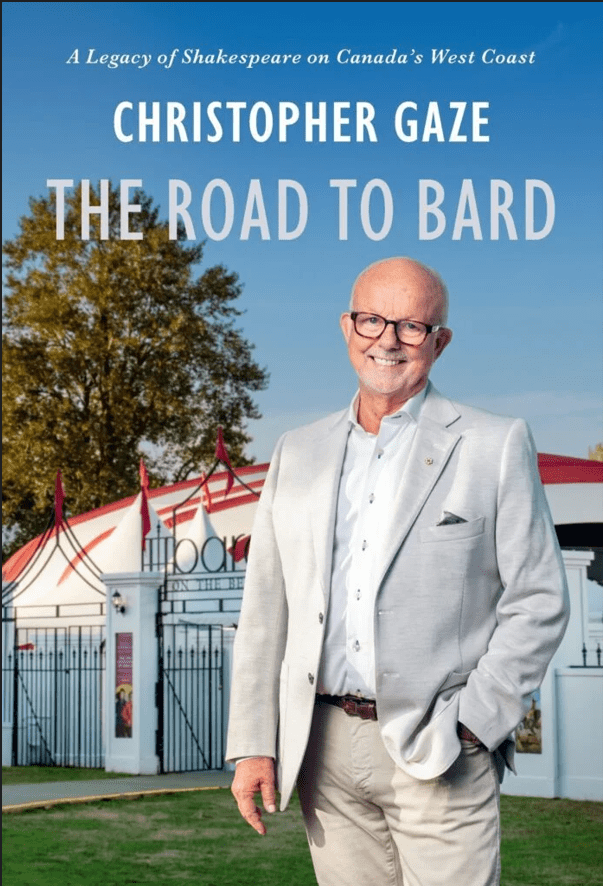
 Christopher Gaze’s memoir The Road to Bard is not only one man’s story of a life filled with adventure. It is far more. The Road to Bard is also a celebration of theatre and the story of one man’s deep love for Shakespeare.
As a young boy growing up in England, Gaze’s love of theatre and performing was paramount. Sent to boarding school at the tender age of eight (the usual practice for well-to-do families at that time), he quickly learnt how to become independent and resolute while still retaining a deep love for his parents and sister all his life. His father might well have wanted him to go on to university, become an academic, and then follow in the family business, but Christopher had other plans. His parents, however, supported all his choices and soon agreed that he should follow his own chosen path in life.
Throughout his life, Gaze was mentored and helped on his journey by many people who saw his potential as an actor, the most notable being Douglas Campbell, the well-known Scottish actor. The book is in fact peppered with many such celebrity names but is not simply a “Who’s Who” of name dropping. Instead, each celebrity name comes with an amusing story. Discovering these nuggets of information is a particular pleasure. Celebrities such as Tyrone Guthrie, Anna Casson, Bruno Gerussi, Dame Sybil Thorndyke, Pierre Trudeau, Glynis Leyshon, Anne Reid, Jimmy Patterson and so many actors—far too numerous to name them all—are found within the pages of the book.


But success did not come easily to Gaze. He worked hard as a struggling young actor and frequently mentions how fate perhaps moved him on his journey—from the teacher at boarding school, to time at Theatre North, to first meeting Douglas Campbell who saw his potential and mentored and assisted him through the decades and became a lifelong friend.
Gaze writes about his journey to Canada aboard the Stefan Batory. “The next morning, May 14, 1975, I dragged my trunk across London to Tilbury Docks, where I boarded the ship and found my cabin.” Despite a bad case of seasickness, Gaze still found time to perform with another actor aboard ship. Being in front of an audience and entertaining them was where he was always in his element.
The journey across the North American Continent was assisted by the many letters of introduction Douglas Campbell had given him, but he still needed to prove his worth and make money until his acting career took off. One such job opportunity came for him to work as a ranch hand in Montana.

Back in Canada, connections with the Stratford Festival increased his love for theatre and Shakespeare. Readers will particularly enjoy the infusion of Shakespearean quotes and poems throughout the text. This is Christopher Gaze at his best and one can feel the presence of the Bard as he journeyed on.
Eventually, Gaze found his way west always searching for what he felt he needed to do with his life. He was sure he had not yet fulfilled his purpose, what he was always meant to do.
In his memoir he is also not afraid of exposing his personal life; his first romantic relationship with a struggling actress he lived with while at Theatre North in England; his many lovers; his love and respect for his first wife and the blame he places squarely on himself for the marriage breakdown; his love and adoration for his two sons and now his grandchildren, and his love for his current wife, Jennifer, who gave him a chance at finding love again.

He holds nothing back and his true feelings and emotions drip through every page. The words he speaks and shares with his readers at his mother’s Celebration of Life, for instance, are particularly emotional.
In Shakespeare’s immortal words:
All the World’s a Stage and all the men and women merely players; They have their exits and their entrances, and one man in his time plays many parts.

Gaze gives praise to all those “players” in his own life who helped him along the road to Bard and tells how he first conceived the idea of a Shakespeare Festival in the West with Bard on the Beach in Vanier Park, Vancouver. He then writes about the many challenges they had each year to bring this all about between 1990 until today (a list of every production from 1990 to 2026 can be found on pages 315-317). These challenges ranged from gale force winds that almost ripped their first tent apart; actors who fell ill at the last minute; lighting and sound issues; raising funds to keep going; and perhaps the greatest challenge of all—COVID when they were forced to close down for a season but discovered the joys and agonies of learning a life of Zoom!
Gaze himself played many parts in organizing Bard on the Beach—as an actor, a fund raiser, a security guard, an auditioner, and a director, but he did it all happily and continues to do so. To explain this at the end of his final chapter (All’s Well that Ends Well) he uses the beautiful words of George Bernard Shaw to express his own feelings:
This is the true joy in life, the being used for a purpose recognized by yourself as a mighty one: the being thoroughly worn out before you are thrown on the scrap heap; the being a Force of Nature instead of a feverish, selfish little clod of ailments and grievances complaining that the world will not devote itself to making you happy….
The Road to Bard is indeed one man’s joyful journey to his destiny and you will not soon forget his story.
