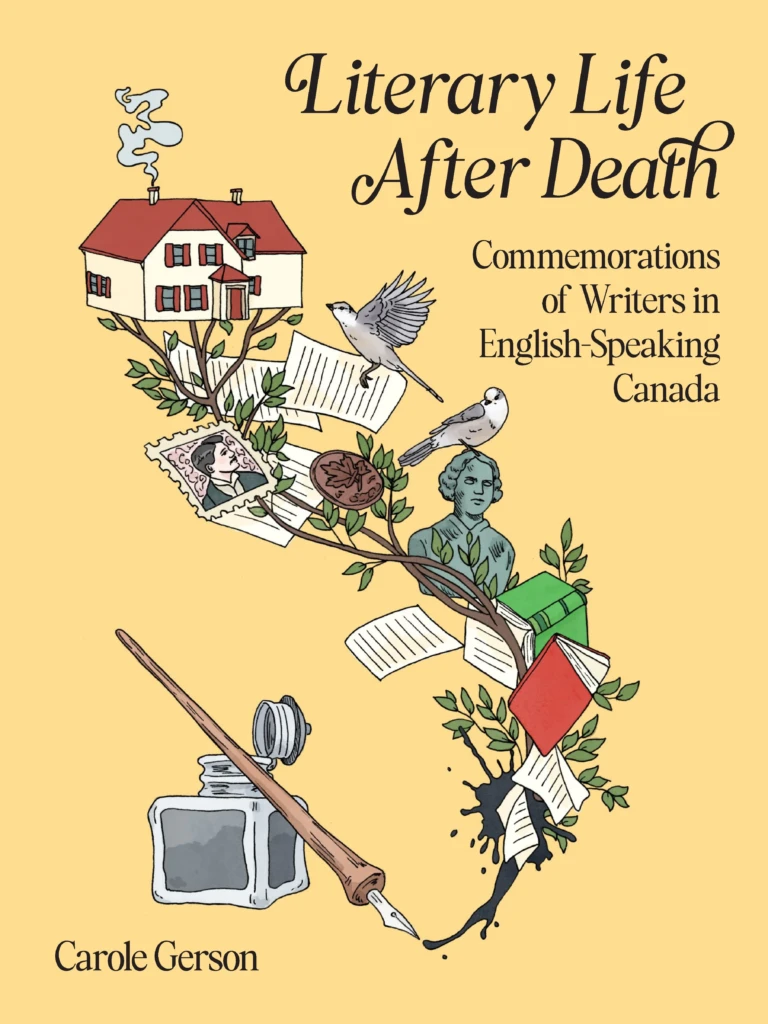

 As a reviewer, I did not know what to expect from a book with a title like Carole Gerson’s Literary Life After Death. Nonetheless, I found these commemorations of writers in English-speaking Canada to be quite fascinating. The book will soon become a great work of reference for researchers of long departed writers and for students studying literary works.
Gerson has covered a wide gamut of posthumous writers, and her book is a comprehensive picture of who and why we honour our favourite literary giants long after their demise. “The focus of this book on literary commemoration in Canada is not on how writers preserve memory but on how memory preserves writers,” Gerson writes.
Personally, I found the book more enjoyable by first checking the table of contents and then choosing a particular chapter to read. For instance, after a very long and involved introduction, Gerson jumps into the ways of commemoration in Chapter One.
She begins with the words of Astrid Eril’s thesis that “cultural memory is unthinkable without media” and she also asserts that “the history of memory is the history of media.” She then writes of how she perceives media, and how it “assembles assorted modes of authorial commemoration in Canada.” This observation ranges from honouring writers on literary maps, postage stamps, plaques, coins, and in the names of parks—because writers are immortalized in those many ways.

Chapter Two visits writers’ homes which I particularly enjoyed, beginning with Carr House (home of Emily Carr in Victoria, British Columbia), and tells stories of several writers’ places of residence across Canada and around the world. The chapter covers some memorable childhood homes of writers as well. This is an excellent reference on the subject.
In Chapter Three, the author concentrates on the appeal of L.M. Montgomery, a Canadian author best known for her collection of novels, essays, short stories, and poetry from 1908. She was, of course, best known for her book Anne of Green Gables written that year. Montgomery has been commemorated in many ways through the years via statues, on coins, and, of course, through Anne’s house, Green Gables, at Green Gables Heritage Place in Cavendish, on Prince Edward Island.
Chapter Four concentrates on Pauline Johnson’s multiple media of commemoration. Johnson and Montgomery “were born thirteen years apart . . .and were contemporaries during the last decade of the nineteenth century and the first of the twentieth, when both achieved extensive recognition as prominent English Canadian authors, yet their paths seldom crossed,” states Gerson.
She adds that other than maintenance of Johnson’s grave and a monument in Vancouver’s Stanley Park, commemoration of her has been sparse which is unusual. Pauline Johnson did, however, “almost achieve a new level of recognition when she was one of the five nominees short-listed in 2017 as candidates to appear on the new ten-dollar bill to be dedicated to celebrating a Canadian woman.” Viola Desmond was, however, finally chosen.

Chapter Five addresses the afterlives of Canadian writers both in performance and in print. “Although posthumous appearances on the stage and on the page have shaped the afterlives of many different Canadian writers,” writes Gerson, “rare is the author who has written creatively about more than one such precursor, other than Atwood.” This same theme is carried through into Gerson’s conclusion where many fascinating gems of information can be discovered by the observant reader.
All of this is followed by in-depth notes and a very helpful index.
The book is peppered throughout with images of statues of people like John McCrae, writer of the poem ‘In Flanders’ Fields,’ and Emily Carr best known for her art but also a writer of such notable books as The House of All Sorts.
Gerson does not neglect literary greats like Shakespeare, Dickens, and Longfellow, and also pays tribute to more modern writers like Alice Munro and Margaret Atwood. Although this book is a heavy academic read, themes of humour are also included to lighten the dense and weighty text.
At the beginning of Chapter Five, Gerson writes: “When literary and cultural critics now use the term ‘afterlife’ they are not talking about the posthumous activities of a departed writer’s spirit but about the ways that an author’s works and characters acquire fresh significance and new incarnations in the hands of subsequent writers and admirers.”
For me, that sentence alone summed up Gerson’s book: how we respect and honor our heroes from the past is an important part of who we are today.