

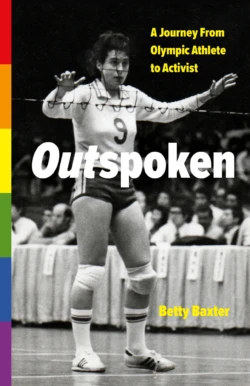
 I cannot profess to be an athlete or a sports enthusiast. For that reason, I falsely assumed I would not enjoy Betty Baxter’s book Outspoken. I played netball and tennis at school and kept playing tennis until well into my twenties. After I moved to Canada, I became a keen hockey spectator and have always been an enthusiastic soccer (football) fan. Volleyball, however, is something I know little about and volleyball is the subject of Better Baxter’s book.
Baxter’s book, however, holds a far deeper message in addition to her journey as an Olympic athlete through the sport she came to love, and I was surprised to find her story held my attention.
The foreword to the book is written by Todd Ross, co-chair of the LGBT Purge Fund, who helped and supported Baxter on her journey as she spoke out for fairness in all sports. Baxter’s opening words are strong and compelling as she describes a night meeting she was summoned to in November 1981 by The Canadian Volleyball Association at a roadside motel between Ottawa and Montreal.
“A light snow drifted through the cold night air as I pulled into the parking lot,” Baxter writes. She was then living in Ottawa while coaching volleyball, first at the University of Ottawa, “and more recently as the head coach of Canada’s national women’s team. At twenty-nine I was breaking ground in the volleyball world as a rare woman coach leading a team internationally.” But she had a sense of foreboding about this meeting. It turns out her instincts were right.

The three men in the hotel room were all powerful men, and their greeting was not warm. The association’s president indicated a chair for Baxter to sit on. He began the meeting quickly with the words: “There are rumours you are gay. Do you deny that?”
“I assure you I am the same person I’ve been as an elite athlete with this association for over a decade, I’ve been the Olympic captain. I’m the same person who has worked hard these past years to learn international coaching,” she replied.
The President continued. “Do you deny it?”
“No. Why is it relevant?”
But this was 1981 and his reply was simple. “You never would have been given this job if I had known that!” In those days no parent would have wanted their daughter coached by a lesbian! The meeting was over and Betty was fired in January 1982.
Baxter’s story then goes back to her childhood. She was born in 1952 in Brooks, Alberta, and attended the Brooks Composite High School. As a small-town prairie girl, she soon discovered her love for all sports. She was an outstanding athlete who played many sports, so she decided to try out for the volleyball team but initially was rejected. Admittedly she had only tried out, knowing little about the game but was intrigued by the new coach, Mr. Lawrence, who was also the drama teacher. He looked like a hippie with “his long, black hair and sporting a goatee beard.” Despite not making the team at first, Mr. Lawrence approached her later and told her he would take her on because of her height and athletic strength.

So, her journey began. Through years of hard work, harsh coaches who pushed her to unimaginable heights, and eventually becoming the first female coach of a national volleyball team between 1980-1982, she was admired around the world.
Then her career was over so Baxter decided she would instead become an outspoken advocate for equality for women in sports. She initiated a new coaching school and worked for a healthy and visible LGBTQ community through Gay Games in San Francisco.
The author does not include her own personal experience as a gay woman during those years. She confines her story only to sports, but I think it might have been interesting to hear how this attitude towards gay people also affected her personal life. She only briefly mentions a girlfriend here and there. Her experiences would have added more substance to her memoir.
Baxter had achieved years of international success for volleyball and women’s sports in general, and was celebrated around the world for her success, but at the young age of twenty-nine had been tossed aside simply because of her sexual orientation. Her internal rage at this unfairness inspired her to become an activist and expose the inequalities and flaws in elite Canadian sports.
This book strongly brings out her message of hope for all men and women in sports to strive for success despite the cost.
Sadly, even forty years later, some of those same issues, particularly for women, remain. “There is still so much more work to do,” Baxter expresses to future generations.