

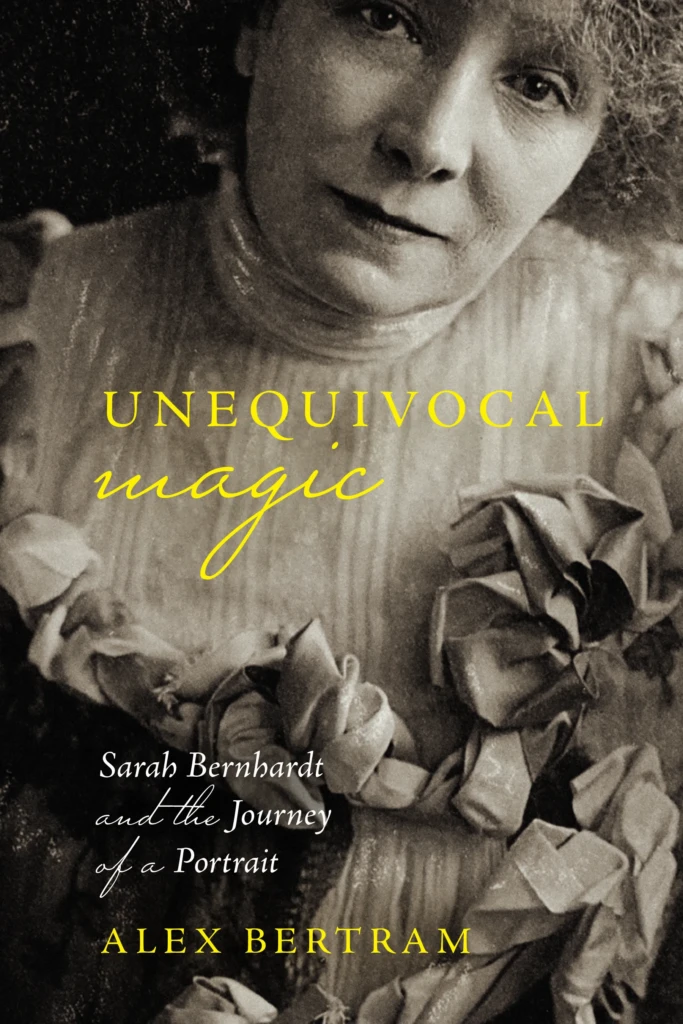
 Sometimes you see an image, and it stays with you. There is something unexpected that holds your attention. You blink—a human camera—and capture a picture that remains in your memory.
With these words, author Alex Bertram begins her personal journey into the history of a 1910 portrait of the famous French actress Sarah Bernhardt, who was herself an enigma. Supposedly born in 1843 (or perhaps 1844 – even that was questionable) “everything about her early years is elusive.” We do know that apparently, she was rejected by her mother and never knew her father. The author believes that because of that rejection by parental guidance “she devoted her career to capturing, instead, the undivided attention of her audiences.”
But the book is not entirely about Bernhardt. The author was in fact setting out to research the forgotten iconic photographer, H. Walter Barnett. She visited the Victoria & Albert Museum in London where she came across this particularly intriguing photograph of Bernhardt taken by Barnett when Bernhardt was much older, and her career had by then already spanned over fifty years.

The photograph led Alex Bertram on a journey to “liberate Bernhardt from the static image,”and find the story behind it. “For reasons I could not grasp, I wanted to know how this portrait made in a London studio in 1910 made its way onto the front cover of an Australian exhibition catalogue in 2001,” writes Bertram.
She began her research by going back to the time when the portrait was taken in 1910 and looking for the photographer’s studio in London, but the more she delved into the story, the more questions she had.
I must admit I personally found Bertram’s journey heavy-going to read, but I think that researchers and students of photography as well as those who are interested in the enigmatic Bernhardt will find Bertram’s book very useful as an academic resource. For me, I found the chapter on process at the end of the book a much easier way to trace this journey: the author separates this chapter into various topics such as Phenomenology and Materiality: A Combined Approach, Material Culture History, Cultural Biography, and Why this Photograph.
This chapter is followed by a very helpful bibliographic essay which begins: “In works of creative nonfiction, such as this, the evidence of the creative nonfiction is built both into the narrative through the use of natural language and the author’s self-aware point of view.”
I assume this is Bertram’s way of explaining why she chose to write her book in the style of creative writing, part telling and part showing.

To complete this work, there is a thorough index and a bibliography of books in the Life Writing Series published by Wilfred Laurier University Press. There are excellent illustrations throughout the book of photographs and portraits including of course the mystical image of Bernardt on Page 43.
By the end of the book, I could not understand if Bertram discovered why this photograph had captivated her, but other readers might by the final pages. As a reviewer, I was more intrigued by Sarah Bernhardt’s story. “Bernhardt constantly eluded her reviewers and her audiences,” Bertram writes. “Yet despite her obfuscations, avoidances and just plain lies, we can track her path and (more importantly) begin to grasp her essential nature.”
Bernhard’s career was indeed varied and full including both acting and singing. She also travelled widely, even on one occasion visiting Victoria, British Columbia. Her personal life included many lovers. She was once the mistress of Henri, Prince de Ligne, and gave birth to her only child, Maurice. Later she married Jacques Damala, a Greek military-officer-turned actor, but the marriage did not last long, He eventually died from drug abuse. She continued to have many affairs with famous men, including French writer, Victor Hugo and the Prince of Wales, the future King Edward VII.
I am sure that Bertram was also fascinated by the woman behind the portrait as she later claims: “Intrigued by Bernhardt’s experiences, as part of my photographic journey, I explore the origins of the classical art of memory. Image and place played important roles.”
Bertram has successfully combined her photographic research with her own personal journey after seeing the magical portrait of the unfathomable Bernhardt. Her life alone is worthy of a book.