

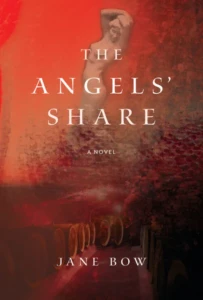
 The Angels’ Share by Jane Bow (Homeless) is a combination of many elements—slow-burning passion, art, wine, sex, adventure, crime—that somehow the author manages to weave together into a thought-provoking book.
The book tells the story of how Dion (Dionysia), a thirty-nine year old woman, decides to leave her boring government job in Canada and journey to Crete to help her American-born father (Alex) and her feisty, Cretan, ninety-four year-old, ex-resistance operative grandmother (Ayatah) save her family’s winery from the claws of a powerful Russian oligarch (Leo) to whom they are already in the sort of debt that they would never be able to pay off.
The book begins on the day Dion decides to briefly take time for herself and escape from the financial worries of the family vineyard. She leaves the house, climbs over a wall to her favourite place, a hidden cove. There she spreads a blanket and lies down. The late afternoon sunshine invites her to be daring and remove her clothes and is also inviting a passion she has never known in any past relationships. Suddenly she realizes she is being watched and she jumps up to cover herself.
That is the first meeting with Theo, an artist who paints nudes while living a somewhat reprobate life in a castle ruin on the nearby mountain. He tells Dion he wants to paint her, but she is reluctant to allow him to paint her in the nude. Nonetheless she returns repeatedly to meet with Theo as he slowly and seductively paints parts of her body—a hand, a foot, her face—until she finally agrees to remove her clothes for him and paint her entire body.

Passion slowly grows between them. Regrettably, these scenes are somewhat repetitive and soon become boring. Maybe there should not have been quite so many. A later scene borders on erotica which some readers might find distasteful. A few of these scenes were perhaps necessary to emphasize a point the author was trying to get across to her readers—the buildup of passion between a woman who thought of herself as “over the hill” as she approached forty, and a younger man who had always thought of painting nude women as an art and nothing more. Slowly these points of view change for them both and a relationship grows.
The story picks up when Dion meets Amina, a woman who is running away from a marriage to a wealthy Saudi businessman. Dion listens to her story of how she grew up in America but at eighteen was sold by her Armenian parents to the Saudi. Amina agreed to the marriage, imagining a lifestyle of wealth, love, and happiness, only to find she had become part of his harem of wives. As she was both beautiful and well-educated, she soon became his favourite wife, and he took her with him as he made deals around the world.
Nonetheless she was a virtual prisoner for thirty years, always at his beck and call and living a life she finally managed to escape. She made her way to Crete where Dion meets her and offers her refuge with her family at the vineyard. She did not realize that once Leo the Russian met Amina he would become fascinated with her and Dion feared she might well become involved in a similar relationship with another wealthy man.
Readers will particularly enjoy one aspect of the story as they are plunged into descriptive passages of Crete, the wine industry, and strong family tradition. We learn that Dion’s older brother Teddy died when they were children. She adored him and his adventurous spirit and throughout her life has channeled him as she asked, “what would Teddy do?” whenever she is faced with a problem. This allows her to keep him close while valuing the choices he made.

The same happens with her grandmother Ayatah, who talks every night to her late beloved husband before she retires to bed. She longs to be with him again but must be content with asking him questions as to what she should do whenever she must decide on something. And she realizes she still must tie up loose ends on earth before she sees her husband again. She wants to make sure the vineyard stays in the family and remains a climate-conscious winemaking business.
My one other small criticism of Bow’s book was the intrusion of back story which although necessary tended to slow down the progress.
Even so, the most important part of the story is how the family are going to save their vineyard from ruthless international interests. Dion, Theo, and Ayatah come up with an ingenious plan of stealing something from the Russian and paying their debt back to him with his own money. The plan, however, is complicated and must be carried out with precision and bravery. Dion cannot imagine herself as a criminal—but is there any other way if they want to save their livelihood?
This part of the story is very well done. The heist is tense with many twists, turns, ups and downs, and holds the reader’s attention until the final scene. To explain it in more detail would spoil all the surprises along the way.
The Angel’s Share is well-travelled Victoria-based Bow’s fourth novel. Her fascinating and eloquent prose portraiture of Crete and Greece is beautifully painted here from her obvious knowledge of many places around the globe.