

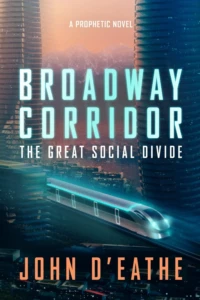
 In the “prophetic novel,” Broadway Corridor: The Great Social Divide, D’Eathe introduces his readers to a world set in the near future of Vancouver.
The Broadway Corridor today is a major urban hub with many key areas—Vancouver General Hospital, False Creek Flats and UBC, for example. This area is currently undergoing a large transformation via the Broadway Subway Project, with a plan to add the SkyTrain, denser housing, and jobs (in both technology and health) to create a vibrant, walkable, transit hub. This is a 30-year vision for Vancouver.
Fast forward to the middle of this century and discover in D’Eathe’s book what the Corridor might look like by then. It is a thought-provoking, frightening picture of the world along the Corridor, where AI assistants are the norm, where wealth is everywhere, where the Canadian health system is broken and in great jeopardy, and where a social divide between the “haves” and “have-nots” is apparent everywhere.
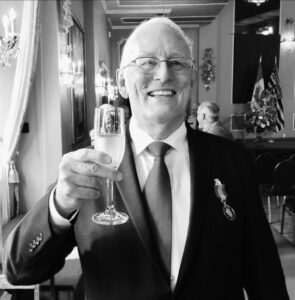
D’Eathe (Laundering the Dragon) situates his story in this one strip in Vancouver, the Broadway Corridor, although social decay is also a Canada-wide problem by then. The train line running between the UBC and Jericho Beach is now controlled by wealthy businesspeople living in ultra-modern skyscrapers, or by criminals (of the organized and free agent variety). Plus, there are illegal medical procedures and surgeries being performed by dedicated surgeons who understand that the less wealthy cannot pay for expensive medical care the regular way.
Into this strange, yet (possibly) prophetic scene, readers meet varied characters. I was glad the author had provided a “cast of characters” at the beginning of the book because the story soon grows very complicated. We first meet Assistant Commissioner, Ivern Hill, who as part of the Medical Police is observing an illegal medical practice from an observation camera. He’s soon mesmerized by the eyes of the woman performing the surgery—moments before police rush in firing shots to break up the so-called illegal ‘crime.’ Some escape but three are shot.
Dr. Janet Madison (Maddie) is the surgeon with beautiful eyes, and the growth of her relationship with Ivern, initially on opposite sides of the medical issue, is well portrayed as they eventually fall in love and are honest with each other. Other couples in the story are Dr. James and Fatima Khan. James is the President of the BC Medical Association and Fatima is a friend of Maddie from college days. Another couple, Samuel and Zuri Nkosi, both have PhDs and are geniuses in technology. Dr. Simeon Chiu, another character, is the Dean at the UBC’s Medical School. Carlo Santos, Ricardo, Joey and Juan are career criminals, and someone called Timothy Lam is a blogger who relates the news as it breaks. We also meet Inspector Jules McIntosh of the RCMP, the Honorable Irene Ito, Minister of Health, and the Honourable Joe Jahani, the Premier of British Columbia.
All these characters in the cast have the name of the station area where they live along the Corridor, which is helpful as the story progresses.
And then there are Pookie and Sazu, the Artificial Intelligence Companions to the humans who, although programmed by the humans, can advise and sometimes control their masters.
I will not disclose the many complications of life along the Corridor, but a conversation between Samuel and Zuri late in the novel perhaps sums up my thoughts at that point:
“And she [Maddie] lives with the chief of police [Ivern] and is making all friendly to us. Doesn’t that concern you?”
“Now that you mention it, yes. But I like her.”
“That’s the problem. Then there is her friend James Khan from the Medical Association. Between them I think they are an incredible threat or a valuable link.”
“They probably know more than we think. But where does the policeman fit in all this?”
“Haven’t a clue!”
I was beginning to feel the same way about the entire book by then. What was going on? I enjoyed the relationship between Maddie, the beautiful surgeon, and Ivern, the cop, but found the other characters to be strange despite being described with substance. Will people be like that in the 2050s? Will the Corridor eventually erupt in violence as is forecast?
Overall, this is a futuristic look at life in the upcoming mid-century where the medical system is broken, zones are used freely to attack people, individuals mistrust one another and question one another’s motives, and perhaps artificial intelligence rules.
It is a somewhat depressing thought, but as John D’Eathe says in his Acknowledgements, “It is the way things are heading and may indeed prove prophetic. Certainly, Pookie would agree!”