

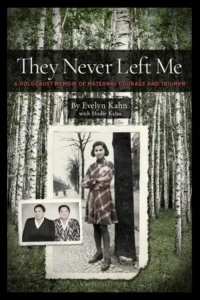
There have been many books written about the Holocaust, but the memoir They Never Left Me, written by a Holocaust survivor, Evelyn Kahn, assisted by her daughter Hodie Kahn, is very different and extremely powerful.
It is different because the story is told through a child’s eyes (Evelyn’s) as she recalls how her mother and grandmother made sure she would survive and be able to tell their tragic story. It is also unlike other books about the Holocaust because it describes life before, during, and after the war for those survivors. This makes it more formidable and in parts riveting.

Evelyn’s memories are sometimes fragmented and even complicated with the mention of many names of people she remembers, some Polish, some German, and some Russian. A glossary at the end of the book helps the reader understand the meaning of the words used.
The story begins in the early 1930s as Evelyn recalls her childhood in a Jewish section of Poland. She was born Ewa Landsman in 1933 in Eishyshok, a Jewish community in Eastern Poland. Her parents, Moshe and Basia Landsman, created an idyllic childhood for her. The first part of her book tells of her loving close-knit family and her parents’ and grandmother’s histories. She also illustrates many of their beloved Jewish customs in detail—High Holy days such as Rosh Hashanah and Yom Kippur. On those special occasions Evelyn recalls “I have special memories from around age three or four of going with my mother to the dressmaker to have new clothes made for those occasions.” The first six years of her life were “the happiest of my early life,”she recalls. Her actual birth was difficult for her mother and for her, so she was treasured by both parents and had an especially loving relationship with her father.
In those early pages of the book, there is a lot of description of Jewish life that is most probably included to emphasize the later horror of how Nazism attempted to annihilate everything the Jewish population held dear.

Photo courtesy Evelyn Kahn
Even the years leading up to Germany invading Poland and the beginning of the Second World War, were horrific for Polish and German Jews. Kahn relates her story leaving Eishyshok, moving to Lida and then to Zhetl, always on the run from the Nazis. The use of small side bars within the text of the book allows the reader to understand the history of events leading up to Hitler’s “Final Solution to the Jewish Question” when it became obvious that the Nazi regime’s plan was to exterminate all Jewish people from Europe.
From February until August of 1942 the family lived in the Zhetl Ghetto. Evelyn describes living conditions as “tolerable.”
I know there were food shortages and sanitation challenges. I know there was hunger and deprivation… but I do not recall suffering due to a combination of the extraordinary strength of my mother and grandmother, the near impenetrable force field of protection they conjured around me, and my own magical thinking. My defenses were strong. Mama and Bobe were like steel. The stoicism they modelled for me became part of my own self.

During this chapter, Evelyn Kahn talks of her beloved Uncle Chaim who as a Partisan helped them, and her Aunt Rivka who was suffering greatly because of her impending pregnancy. Rivka’s son, Joe, was delivered in despicable conditions just before they were forced to move on yet again. “We needed to move. Death was chasing us. Perhaps it would not find us in the depths of the forest.”
So, from August 1942 until September 1944, they became part of thousands of Jews who sought refuge in the forests of Eastern Europe. Later, Evelyn learns of the death of her beloved father, who had earlier volunteered to help the Soviet Army against the Nazis. This news devastates her as a small child as does the news of her Uncle Chaim’s death.
It is estimated that twenty to thirty thousand Jewish partisans and civilians lived in those woodland sanctuaries, and only about one-third to one-half of those walked out after Liberation. During those two years they had constantly been on the move, being one step ahead of the hunters who sought them. They suffered starvation, disease, an invasion of lice, and both heat and frigid temperatures, and even when they were told by the Partisans that liberation had finally come, they were still in danger.
Jews were now refugees, displaced persons, so more horrors lay ahead. The book describes the refugee camps and the movement of thousands of Jews with nowhere to go. Many, like Evelyn and her mother, would love to have gone to the so-called Promised Land, Israel. Through a long process of paperwork and many necessary name changes for Evelyn—Ewa Landsman, Howa Krawa, Eva Krawa, Howa Schuster, Evelyn Landsman, and Evelyn Kaganowicz—they eventually ended up in Berlin.

Then in December of 1949, they finally left Europe for good and travelled with 1,267 other Jewish survivors to New York aboard the USS General Harry Taylor. They had been sponsored by some distant cousins who lived in New York City. Evelyn felt sad to leave behind her roots but at the age of sixteen now looked forward to a brighter future. Even in New York, as refugees, they were looked down upon but never lost their resolve to survive and overcome.

Photo courtesy Evelyn Kahn
Evelyn later met and married another Holocaust survivor, Leon Kahn, and she officially changed her name for the last time to Evelyn Kahn. The couple eventually moved to Vancouver in Canada and raised their family there.
The epilogue is interesting because it tells the reader what happened in the future to all the family—Hoda, Basia, Rivka, Joe, and Evelyn—and how all their lives were ultimately affected by the Holocaust.
Evelyn Kahn, now in her nineties, has opened her heart in this story to recall so many painful memories. It is her tribute to maternal love. She is a child Holocaust survivor who, in her own words, states:
I always feel blessed to have survived. I still wonder how I did. Divine providence, good fortune and the unwavering courage of others—certainly. But I believe the quiet, steady presence of profound faith, nurtured in me from the time I was born, also played a critical role. Because faith is hope. Even in the bleakest moments of the Holocaust, as the Nazis stole everything—including the lives of beloved family members—they never managed to steal that. Faith shaped the chaos of my life and offered meaning beyond mere survival.
This book moved me beyond words and should be read by all generations to make sure the Holocaust is fully understood and, more importantly, to ensure that such horror will never happen again.